NCLEX Musculoskeletal & Mobility Review: Fractures, Casts, Hips & Assistive Devices
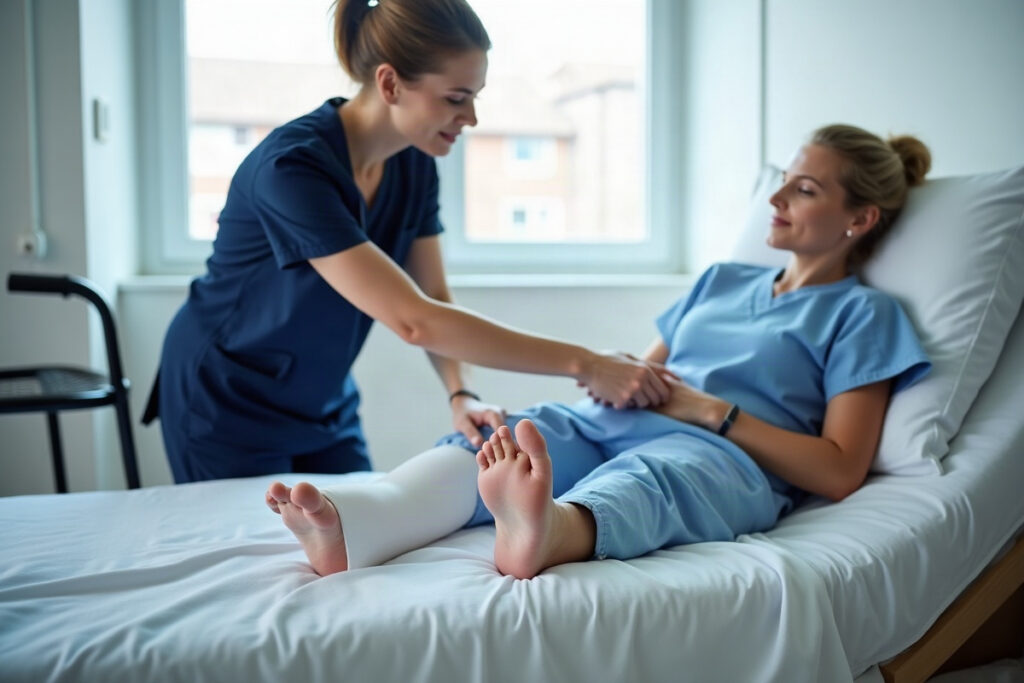
Musculoskeletal questions on the NCLEX rarely ask you to name a bone. They ask what you do when a patient in a new cast says the pain is getting worse, or which instruction a patient with a hip replacement needs corrected. The content is mostly about complications you must catch early and teaching you must get right. This review covers the high-yield topics: neurovascular checks, the two fracture emergencies, casts and traction, hip surgery, arthritis and gout, osteoporosis medication teaching, and assistive devices.
Neurovascular checks: the assessment behind most questions
Any time a limb is injured, casted, splinted, in traction, or just out of surgery, you compare it with the other side. Check:
- Color and temperature — pale, dusky, or cool is a concern
- Capillary refill — brisk refill (under about 3 seconds) is expected
- Pulses distal to the injury
- Sensation — numbness or tingling
- Movement of fingers or toes
- Pain — especially pain that is increasing or out of proportion
On the exam, a change from baseline matters more than any single finding. A patient whose toes were warm and pink an hour ago and are now cool with new tingling needs action now, not a note in the chart.
The two fracture emergencies: compartment syndrome and fat embolism
Compartment syndrome happens when pressure builds inside a closed muscle compartment, often under a tight cast or dressing, or from swelling after a fracture or crush injury. Blood flow to the muscle and nerves is cut off. Watch for:
- Pain out of proportion to the injury that is not relieved by opioids — the earliest and most important sign
- Pain with passive stretch of the muscle
- Tightness, numbness, tingling
- Pallor, weakness, and loss of pulse are late signs. Don’t wait for them.
Nursing actions: notify the provider immediately, loosen any tight dressing (the provider may bivalve or remove the cast), and keep the limb at heart level. Elevating it above the heart or applying ice can further reduce blood flow. The definitive treatment is usually a surgical fasciotomy.
Fat embolism syndrome is most associated with fractures of long bones, like the femur, and the pelvis. It typically shows up within the first few days. The classic picture:
- Respiratory distress and low oxygen saturation
- Confusion or restlessness — often an early clue
- Petechiae on the chest, axilla, or conjunctiva
Priority: raise the head of the bed, give oxygen, and call the rapid response team or provider. Early stabilization of long-bone fractures helps prevent it. Also keep deep vein thrombosis in mind after any lower-extremity fracture or orthopedic surgery: unilateral calf swelling, warmth, and pain should be reported, not massaged.
Casts and traction
Cast care comes up in both nursing-action and teaching questions:
- Handle a wet plaster cast with the palms, not fingertips, to avoid dents that create pressure points. Plaster can take a day or more to fully dry; fiberglass sets much faster.
- Elevate the limb and apply ice as ordered for the first day or two to limit swelling.
- Do neurovascular checks often, especially early on.
- Teach: never put objects inside the cast to scratch, keep it dry, and report a foul odor, drainage, a warm spot on the cast, or new numbness. These can signal infection or a pressure injury underneath.
Traction keeps a bone aligned and reduces muscle spasm.
- Skin traction (such as Buck’s traction) attaches to the skin with a boot or wrap. Check the skin under it.
- Skeletal traction uses pins through the bone. Do pin site care per facility protocol and watch for signs of infection.
- For both: weights must hang freely, off the floor and bed. Do not lift or remove the weights unless the provider orders it. Keep ropes on their pulleys and the patient positioned so the pull stays in line.
Hip fractures and hip replacement
A classic hip fracture presentation: an older adult after a fall with the affected leg shortened and externally rotated, with pain in the hip or groin. These patients are at high risk for delirium, DVT, pneumonia, and pressure injuries.
After a total hip replacement using a posterior approach, the goal is preventing dislocation. Standard precautions include:
- No hip flexion past 90 degrees — no low chairs, use a raised toilet seat, don’t bend forward to put on shoes
- No crossing the legs or moving the affected leg past the midline (an abduction pillow between the legs helps)
- No turning the affected leg inward
- Use a reacher, sock aid, and long-handled shoehorn
Precautions differ by surgical approach and surgeon, so in practice you follow the specific orders. On the exam, an answer where the patient crosses their legs, sits in a low recliner, or bends to tie shoes is almost always the one that needs correcting. Sudden severe pain, a shortened leg, or rotation after surgery suggests dislocation — report it.
Arthritis, gout, and osteoporosis
Know how to tell the two main arthritis types apart:
- Osteoarthritis — degenerative, often in weight-bearing joints, can be one-sided. Pain worsens with activity and eases with rest. Morning stiffness is brief, usually under 30 minutes. Bony nodes on the finger joints are common.
- Rheumatoid arthritis — autoimmune and systemic. Usually symmetric, affecting small joints of the hands and feet. Morning stiffness lasts longer, often an hour or more. Fatigue and low-grade fever can occur. Late deformities include ulnar deviation and swan-neck fingers.
Gout is caused by uric acid crystals in a joint, classically the big toe, which becomes red, hot, swollen, and very painful. Teaching: drink plenty of fluids, limit alcohol (especially beer) and high-purine foods like organ meats and some seafood. Colchicine and NSAIDs treat acute flares; allopurinol is used to prevent attacks by lowering uric acid, not to treat an acute flare.
Osteoporosis raises fracture risk, especially in the hip, spine, and wrist. Teach calcium and vitamin D intake, weight-bearing exercise, and fall prevention. Bisphosphonate teaching is a favorite test item. For oral alendronate:
- Take it first thing in the morning on an empty stomach
- Use a full glass of plain water — not coffee, juice, or milk
- Stay upright for at least 30 minutes to protect the esophagus
- Wait at least 30 minutes before eating or taking other medicines
Immobility and assistive devices
When a patient can’t move, every body system pays: pressure injuries, DVT, pneumonia and atelectasis, constipation, muscle loss and contractures, bone loss, and orthostatic hypotension when they finally stand. Prevention is turning and repositioning, early mobility, coughing and deep breathing, fluids and fiber, and range-of-motion exercises. The safe transfers and body mechanics guide covers moving patients without injuring them or yourself.
Assistive device teaching shows up constantly:
- Cane — hold it on the strong (unaffected) side. Move the cane and the weak leg forward together, then the strong leg.
- Walker — move the walker forward first, then step in with the weak leg, then the strong leg. Stand up by pushing off the chair arms, not by pulling on the walker.
- Crutches — the top should sit about two to three finger-widths below the armpit. Weight goes on the hands, not the armpits, which can damage nerves. On stairs: up with the good, down with the bad. The strong leg leads going up; the crutches and weak leg lead going down.
For prioritization questions, rank the musculoskeletal patient with new neurovascular changes or sudden breathing trouble first. Stable post-op pain or routine teaching can wait. Our prioritization and delegation guide walks through how to make those calls.
Practice NCLEX-RN questions free
Try 60 free sample questions with full rationales — no signup.
Start the free NCLEX-RN practice test →