TEAS 7 Anatomy & Physiology: High-Yield Systems
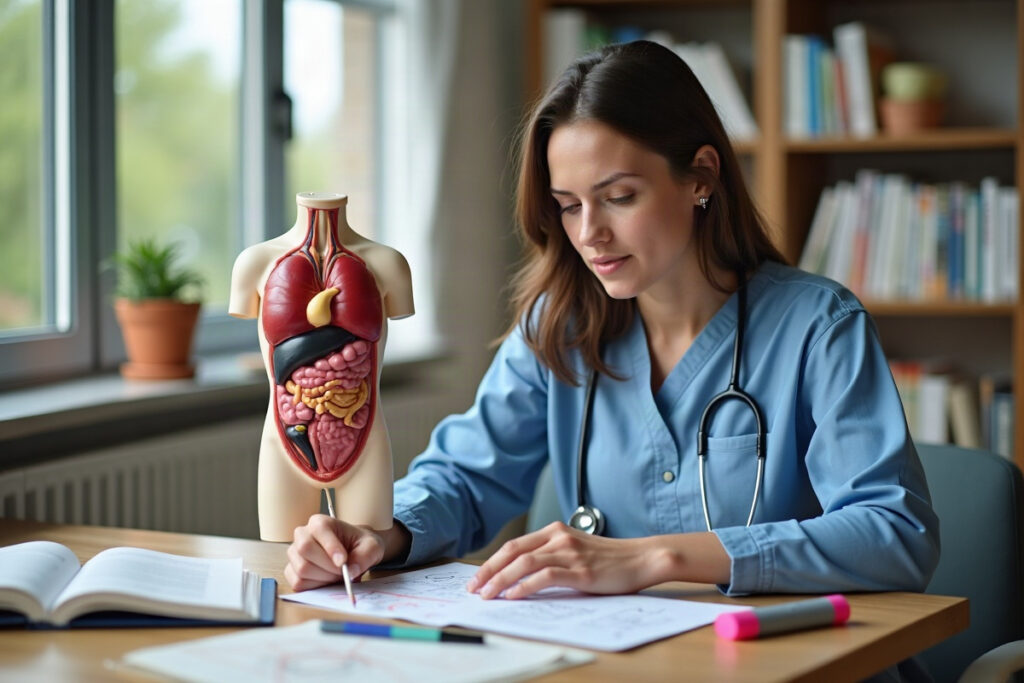
Anatomy and physiology is the biggest piece of the ATI TEAS 7 Science section. If you are short on study time, this is where it pays off most. The good news is that the exam does not expect nursing-school depth. It expects you to know where the major structures are, what each system does, and how the systems work together to keep the body stable. This guide walks through the systems that come up most, the terms you need to read questions quickly, and a study plan you can actually stick to.
How A&P fits into the TEAS 7 Science section
The TEAS 7 Science section covers four areas: human anatomy and physiology, biology, chemistry, and scientific reasoning. A&P carries the most questions of the four, so it deserves the largest share of your science study time. ATI publishes the current blueprint, including question counts and the time limit, so check its official outline before test day in case anything has changed.
Most A&P questions fall into three types:
- Structure: where something is or what it is made of. Example: which chamber of the heart pumps blood to the body?
- Function: what an organ or structure does. Example: what is the main job of the alveoli?
- Connections: how two systems work together. Example: how do the kidneys help control blood pressure?
If you can answer those three questions for each system below, you are in good shape.
Terms that unlock the questions
Many A&P questions are easy once you know the vocabulary. Learn these first:
- Directional terms: superior (above) and inferior (below); anterior (front) and posterior (back); medial (toward the midline) and lateral (away from it); proximal (closer to where a limb attaches) and distal (farther away).
- Body planes: the sagittal plane divides left and right, the frontal (coronal) plane divides front and back, and the transverse plane divides top and bottom.
- Body cavities: the dorsal cavity holds the brain and spinal cord; the ventral cavity holds the thoracic (heart, lungs) and abdominopelvic organs.
- Levels of organization: cells → tissues → organs → organ systems → organism.
- Homeostasis: keeping the internal environment stable. Most body control uses negative feedback, where a change triggers a response that reverses it, like sweating when body temperature rises. Positive feedback amplifies a change, such as contractions during childbirth.
Cardiovascular and respiratory systems
These two are tested often and are easiest to learn together, because their whole job is moving oxygen in and carbon dioxide out.
Blood flow through the heart is a classic question. Learn it in order:
- Oxygen-poor blood from the body enters the right atrium through the vena cavae.
- It passes the tricuspid valve into the right ventricle.
- It is pumped through the pulmonary valve into the pulmonary arteries to the lungs.
- Oxygen-rich blood returns through the pulmonary veins to the left atrium.
- It passes the mitral (bicuspid) valve into the left ventricle.
- It is pumped through the aortic valve into the aorta and out to the body.
Two traps: arteries carry blood away from the heart and veins carry it back, even though the pulmonary arteries carry oxygen-poor blood. And the left ventricle has the thickest wall because it pumps to the whole body.
Respiratory path: nose and mouth → pharynx → larynx → trachea → bronchi → bronchioles → alveoli. Gas exchange happens in the alveoli by diffusion into the surrounding capillaries. The diaphragm contracts and moves down during inhalation, which lowers pressure in the chest and pulls air in.
Nervous and endocrine systems
Both systems send signals that control the body. The difference is speed and method: the nervous system uses electrical impulses and is fast; the endocrine system uses hormones in the blood and is slower but longer lasting.
- Central nervous system (CNS): brain and spinal cord. Peripheral nervous system (PNS): all the nerves outside them.
- Brain regions: the cerebrum handles thinking, memory, and voluntary movement; the cerebellum handles balance and coordination; the brainstem controls breathing and heart rate.
- Autonomic nervous system: sympathetic is “fight or flight” (faster heart rate, dilated pupils, slowed digestion); parasympathetic is “rest and digest.”
- Neuron parts: dendrites receive signals, the axon sends them, and the myelin sheath speeds them up.
For the endocrine system, match each gland to its main hormone and job:
- Pituitary: the “master gland,” controlled by the hypothalamus; releases growth hormone, ADH, and hormones that direct other glands.
- Thyroid: thyroid hormones set metabolic rate.
- Pancreas: insulin lowers blood glucose; glucagon raises it.
- Adrenal glands: epinephrine for the stress response; cortisol for longer-term stress and metabolism; aldosterone for sodium and water balance.
Digestive, urinary, and immune systems
Digestive path: mouth → esophagus → stomach → small intestine → large intestine → rectum. Digestion starts in the mouth with saliva. The stomach breaks food down with acid and enzymes. Most nutrient absorption happens in the small intestine, helped by villi that add surface area. The large intestine mainly absorbs water. The liver makes bile, the gallbladder stores it, and the pancreas adds digestive enzymes.
Urinary system: kidneys → ureters → bladder → urethra. The nephron is the working unit of the kidney: it filters blood, reabsorbs what the body needs, and sends waste out as urine. The kidneys also help control blood pressure, fluid balance, and electrolytes, which makes them a favorite “connections” question.
Immune system: know the difference between innate defenses (skin, mucous membranes, inflammation, phagocytes) and adaptive defenses (B cells make antibodies; T cells attack infected cells and coordinate the response). Active immunity comes from your own body making antibodies after an infection or vaccine; passive immunity comes from receiving antibodies, such as from mother to baby.
Musculoskeletal, integumentary, and reproductive systems
- Skeletal system: supports the body, protects organs, stores calcium, and makes blood cells in red bone marrow. Know the axial skeleton (skull, spine, ribs) versus the appendicular skeleton (limbs, shoulder and hip girdles).
- Connective tissue: tendons connect muscle to bone; ligaments connect bone to bone.
- Muscle types: skeletal muscle is voluntary and striated; cardiac muscle is involuntary and striated; smooth muscle is involuntary and lines organs and vessels.
- Integumentary system: the skin has the epidermis (outer protective layer), dermis (blood vessels, nerves, glands), and hypodermis (fat and connective tissue). It protects, controls temperature, and helps make vitamin D.
- Reproductive system: know the main organs and their roles, where fertilization usually happens (the fallopian tube), and the basic roles of estrogen, progesterone, and testosterone.
A two-week A&P study plan
Spread the systems out instead of cramming them all at once:
- Days 1–2: terms, planes, cavities, and homeostasis.
- Days 3–5: cardiovascular and respiratory. Draw the blood flow path from memory until you can do it without notes.
- Days 6–8: nervous and endocrine. Make a gland-hormone-job chart.
- Days 9–11: digestive, urinary, and immune.
- Days 12–13: musculoskeletal, skin, and reproductive.
- Day 14: a timed practice set across all systems, then review every rationale.
A few habits help the most: say functions out loud in plain words, sketch diagrams instead of re-reading them, and keep a running list of every question you miss. That list becomes your final review. When an answer choice looks right but uses the wrong direction or the wrong organ, slow down — that is how most A&P distractors are built.
Practice ATI TEAS 7 questions free
Try 60 free sample questions with full rationales — no signup.
Start the free ATI TEAS 7 practice test →