Infection Control & PPE for the NCLEX and CNA Exam
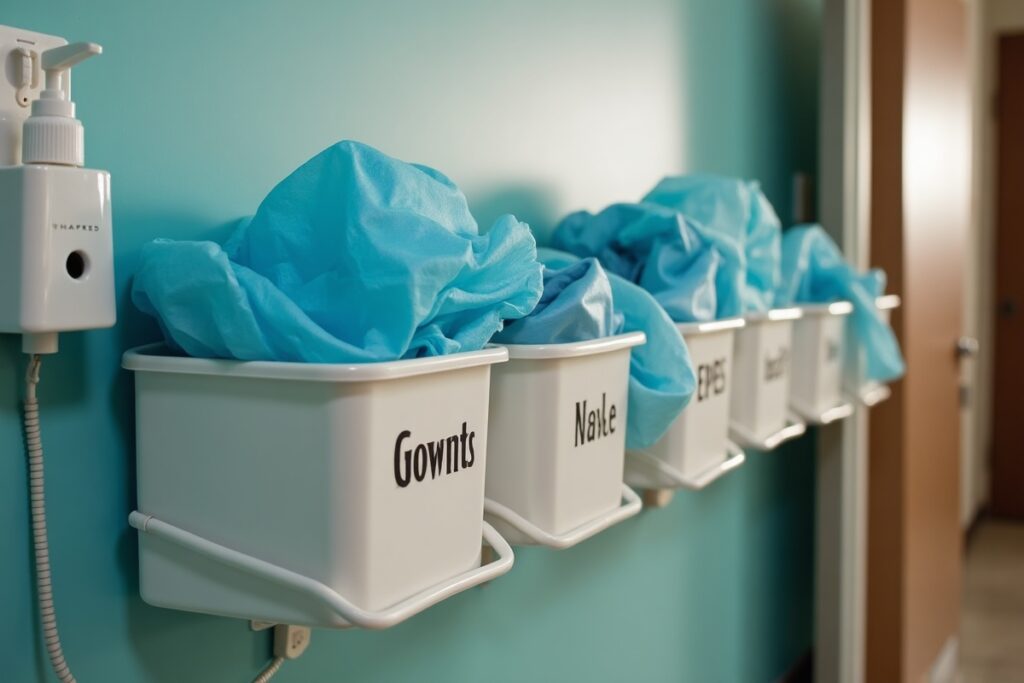
Infection control is one of the few subjects that shows up on every nursing exam you will sit for. On the NCLEX it lives inside Safety and Infection Control, one of the largest client-needs categories on the test plan. On the CNA exam it appears in the written questions and again in the skills test, where handwashing is one of the most commonly assigned hands-on skills. The good news is that this content is highly rule-based — the same handful of principles generate most of the questions, and once you can sort a client into the right precaution category and put on your equipment in the right order, the items become almost mechanical. This guide covers hand hygiene, standard and transmission-based precautions, the PPE sequence, asepsis, and the traps that consistently cost students points. Always follow your program’s instruction and your facility’s current policy in real practice, and check the CDC’s published guidance for the authoritative version of any recommendation summarized here.
Why infection control carries so much weight on both exams
Test writers love this content because it is objective. There is a defensible right answer to “which room does this client need” in a way there simply isn’t for softer topics. Expect it to reach you from several directions.
- Straight recall — which precautions apply to a named organism or condition.
- Sequencing — drag-and-drop or ordered-response items asking you to don or remove equipment in the correct order.
- Room assignment — who can safely share a room, and who needs a private one.
- Delegation and supervision — spotting the unlicensed assistive personnel or student who just broke technique, and correcting it.
- Client and family teaching — explaining why visitors must gown and glove, or why the door stays closed.
It helps to keep the chain of infection in the back of your mind: an infectious agent, a reservoir, a portal of exit, a mode of transmission, a portal of entry, and a susceptible host. Nearly every intervention you will ever pick is simply breaking one link in that chain, and the mode of transmission is the link nurses break most often.
Hand hygiene: the highest-yield answer on the test
Hand hygiene is the single most effective way to prevent the spread of infection, and if it appears as an option in a question about preventing transmission, it deserves a very hard look before you choose anything else.
- Alcohol-based hand rub is appropriate for most routine situations and is faster and gentler on the skin than soap and water.
- Soap and water is required when hands are visibly soiled, after using the restroom, and when caring for clients with spore-forming organisms such as Clostridioides difficile. Alcohol does not reliably kill spores; the mechanical friction and rinsing of handwashing physically removes them.
- Perform hand hygiene before and after every client contact, before a clean or aseptic task, after contact with body fluids, and after touching the client’s surroundings.
- Gloves are not a substitute for hand hygiene. Wash before putting them on and again after taking them off — gloves can have unnoticed defects, and hands get contaminated during removal.
For the CNA skills test, handwashing is scored step by step. Evaluators typically look for turning on the water and wetting your hands first, applying soap, lathering with friction for the required time (commonly 20 seconds — confirm the standard your state uses), keeping fingertips pointed down so water runs away from your clean forearms, cleaning under the nails, rinsing without touching the sink basin, drying with a paper towel, and then turning off the faucet with a clean, dry paper towel rather than your bare hand. Touching the faucet directly at the end is one of the most common ways candidates lose the skill.
Standard precautions: the baseline for every client
Standard precautions apply to every client, every time, regardless of diagnosis or presumed infection status. That phrase is worth memorizing verbatim, because questions frequently hinge on it — you do not wait for a positive culture to protect yourself.
Standard precautions treat blood, all body fluids and secretions except sweat, non-intact skin, and mucous membranes as potentially infectious. In practice that means:
- Hand hygiene before and after all client contact.
- Gloves whenever contact with the fluids above is anticipated.
- Gown, mask, and eye protection whenever splashing or spraying is likely — irrigation, suctioning, emptying drainage, or an uncontained cough.
- Safe injection practices, and never recapping a used needle; dispose of sharps immediately in the puncture-resistant container.
- Respiratory hygiene and cough etiquette, and safe handling of contaminated linens and equipment — hold soiled linen away from your uniform and never shake it, which aerosolizes organisms.
Everything in the next section is layered on top of this baseline, never in place of it.
Transmission-based precautions: contact, droplet, and airborne
Three categories, three sets of equipment. Sort the client first and the PPE follows automatically.
- Contact precautions — spread by touching the client or contaminated surfaces. Wear a gown and gloves for all interactions in the room; use dedicated or disposable equipment. Typical examples include MRSA, VRE, C. difficile, RSV, scabies, impetigo, and draining wounds. A common mnemonic is MRS WEE: MRSA, RSV, Skin infections, Wound infections, Enteric (C. difficile), Eye infections such as conjunctivitis.
- Droplet precautions — spread by large respiratory droplets that travel only a short distance. Wear a surgical mask when working within close range; a private room is preferred and the client wears a mask during transport. Typical examples include influenza, pertussis, mumps, rubella, Neisseria meningitidis meningitis, group A streptococcus, and diphtheria.
- Airborne precautions — spread by tiny particles that stay suspended and travel on air currents. Requires an airborne infection isolation room with negative pressure and the door kept closed, plus a fit-tested N95 or higher respirator. The classic four are tuberculosis, measles (rubeola), varicella (chickenpox), and disseminated herpes zoster — remembered as My Chicken Hez TB.
Two extras worth knowing. Some conditions need more than one category: varicella and disseminated zoster call for airborne and contact precautions. And protective (neutropenic) precautions run the logic backwards — a severely immunocompromised client is placed in a positive-pressure room to keep organisms out, with no ill visitors and strict hand hygiene. Negative pressure protects everyone else from the client; positive pressure protects the client from everyone else. Exams love that contrast.
Donning and doffing PPE in the right order
Sequencing items are free points if you have practiced the order, and near-impossible to reason out on the fly if you haven’t. The CDC’s sequence for putting on equipment is:
- Gown — tie at the neck and waist.
- Mask or respirator — secure the ties or elastic and mold the nosepiece; perform a seal check on an N95.
- Goggles or face shield.
- Gloves — last, pulled over the cuffs of the gown.
Gloves go on last and come off first, because they are the dirtiest item at the end of care. The CDC’s sequence for removing equipment is:
- Gloves — peel the first one off inside out, hold it in the gloved hand, then slide a bare finger under the cuff of the second and pull it off over the first.
- Goggles or face shield — handle by the headband or earpieces, never the front.
- Gown — unfasten, pull away from the neck and shoulders, and roll it inside out into a bundle.
- Mask or respirator — remove outside the room (bottom ties first, then top), touching only the ties or elastic.
Then perform hand hygiene. Note the detail that trips people up: the mask comes off last and outside the door, because the air inside an isolation room is the hazard you are still being protected from. Some facilities teach removing the gown and gloves together as a single step; if a question offers that option, it is usually still consistent with gloves-and-gown before eye protection and mask.
Asepsis, sterile fields, and what the CNA skills test scores
Medical asepsis (clean technique) reduces the number of organisms — handwashing, gloves, disinfecting a surface. Surgical asepsis (sterile technique) eliminates them entirely and is required for invasive procedures such as urinary catheter insertion, sterile dressing changes, and anything entering a normally sterile body cavity.
Sterile field rules generate reliable exam questions:
- The outer 1 inch of the field is considered contaminated.
- Anything below waist level or out of your line of sight is contaminated — never turn your back on a sterile field.
- Moisture wicks organisms. A wet field is a contaminated field.
- Do not reach across the field; open packages away from your body and drop contents in from the side.
- Hold sterile items above waist level and keep talking, coughing, and reaching to a minimum.
On the CNA skills test, infection control is not a separate station — it is embedded in every station and scored throughout. Evaluators watch for hand hygiene at the start and end of every skill, gloves for any task involving body fluids or non-intact skin, changing gloves between dirty and clean steps, keeping linens off your uniform and off the floor, wiping and returning equipment, and providing privacy. Missing a required handwashing is frequently a critical error regardless of how well you performed the rest of the skill.
Common traps and the bottom line
A short list of the mistakes that cost the most points:
- Choosing alcohol rub for a C. difficile client. Soap and water, every time, plus a sporicidal (typically bleach-based) surface disinfectant.
- Reaching for an N95 on droplet precautions. A surgical mask is what droplet calls for; save the fit-tested respirator for airborne.
- Leaving the door open on an airborne isolation room. Negative pressure does nothing with the door propped.
- Wearing gloves in the hall or from client to client. Remove and perform hand hygiene before you leave the room.
- Cohorting the wrong clients. An immunosuppressed client should not share a room with someone who has an active infection, and clients on different precautions generally should not be paired.
- Recapping needles or overfilling the sharps container.
- Forgetting that standard precautions still apply when transmission-based precautions are added on top.
The bottom line: identify the route of transmission, apply the matching precautions on top of standard precautions, and put your equipment on and take it off in the correct order — gloves last on, first off, mask last off and outside the room. When two options both look reasonable, the one involving hand hygiene is right more often than any other single intervention. Guidelines are updated periodically and facility policy varies, so verify specifics against the CDC and your own program before applying them clinically. For the exam, drill these patterns until sorting a client into the right category takes a few seconds — then test yourself on the free practice questions below and read the rationale on every infection-control item you meet.
Practice NCLEX-RN questions free
Try 60 free sample questions with full rationales — no signup.
Start the free NCLEX-RN practice test →